
Tech-bro oligarchy
The impact of war on MENA youth

Note: This is a guest post by Nermeen Murad
A friend and media colleague shared an interesting article with me this week: The Great AI Bubble by Carole Cadwalladr published by Broligarchy.
The article contends that we are in a bubble of artificial intelligence hype where we see massive investment, inflated valuations, over-optimistic belief in transformational impact, driven by what they refer to as the “tech-bro” culture.
There is a hint of 2008 in the argument, a reminder of how the risk-blindness of “finance-bro culture” helped inflate a bubble that finally ruptured with the fall of Lehman Brothers.
Tech-bro culture, I came to learn quickly, refers to a style of thinking common among a certain type of young male tech founder from (primarily) Silicon Valley, and usually one who prizes disruption over reflection, speed over caution, data over lived experience, and “money now” with consequences later.
It is a mix of overconfidence and a “sameness” that produces a remarkably narrow worldview, which has shaped today’s AI world, often blind to the social reality of normal people and their gendered experience. Unlike its older cousin, the “finance-bro,” who wears suits, networks in offices, and speaks the language of markets, the tech-bro works in hoodies, codes from home or café, and speaks the language of innovation even when both are driving bubbles that may burst.
This visualisation provided me, albeit superficially, I think, with an understanding of the argument that the article is making, that there is potentially an AI bubble that may burst, impacting the wider ecosystem of companies, investors, and governments. In other words, the “tech-bro oligarchy” (hence “Broligarchy”) is shaping the narrative and potentially crowding out other forms of innovation or regulation that, in my opinion, is more relevant to “normal people”.
The fear is that politicians and governments are so wholly invested in this narrative and we, in our respective roles in the public, private sectors and other lines of “business”, are following that narrative potentially somewhat blinkered and therefore setting policy, regulation, workplans, and budgets based on the “new clothes” of AI which might not deliver at the scale we all expect or envision.
But even as I was engaging with this argument, I realised how differently it lands in the MENA region. It can be argued that this whole track is potentially irrelevant or mismatched contextually for some of us in the MENA region, that failing to build up, strategize, and operationalise a parallel track to the AI innovation and technology trajectory may lead us to a “fizz” of our own.
There is a real risk that failing to envision parallel routes will leave our young men and women, behind in both time and opportunity and ultimately adding to their disconnect and alienation.
I am not going to discuss the few privileged Arab states in the Gulf that have an abundance of resources and opportunity, and which do not naturally fit into the lived reality of most of the youth in the Arab world. But for the rest of the MENA region, the excitement around AI is landing on a world already split under at least two headings: the stable-but-stagnant and the war-torn-and-collapsing.
Youth and women in both of these worlds face rising expectations and shrinking opportunities, and their lived experiences diverge so dramatically that we are raising two different generations (three with the privileged that I am not delving into now) who may no longer see themselves as part of one shared regional story or timeline.
AI, war, and inequality are creating parallel Arab futures that may not reconcile easily, and more importantly, I don’t think we have strategized to address them in any tangible way.
The first story is of the “stable” but economically strained Arab states. These arguably include Jordan, Morocco, Tunisia (to some extent), Oman, and even parts of the Gulf’s lower-middle tier. In those countries, the youth are faced with an education system that has not yet captured the imagination or potential of its students, high unemployment despite stability, governments aiming to capture and utilize the AI future as a promising economic fix, women with rising aspirations but limited mobility and a brain drain not from war, but from socio-economic stagnation and “blocked potential”.
These youth feel trapped in a predictable, monotone, but unchanging system. Narratives around AI potential inflate their expectations, but institutions, given the limited or mismanaged resources, cannot deliver matching pathways, and therefore, the youth are experiencing what can be described as a “frustrated stability.”
If frustrated stability defines the first group, devastation defines the second. The second story is of the Arab states in conflict or collapse. And these include Syria, Yemen, Gaza/Palestine, Libya, parts of Iraq, and Sudan. And in those countries, the reality of youth is that of survival, not opportunity.
Their education systems have been disrupted or destroyed, they suffer with displacement, trauma, loss of identity and sense of belonging, almost zero access to the global AI economy (bar some TikTok and other social media innovators), and their experience of global inequality is that of total abandonment. These youth are not even in the AI conversation; they are consumers of alien narratives built far away while living in conditions centuries behind that narrative. Their identity is shaped by loss, not possibility.
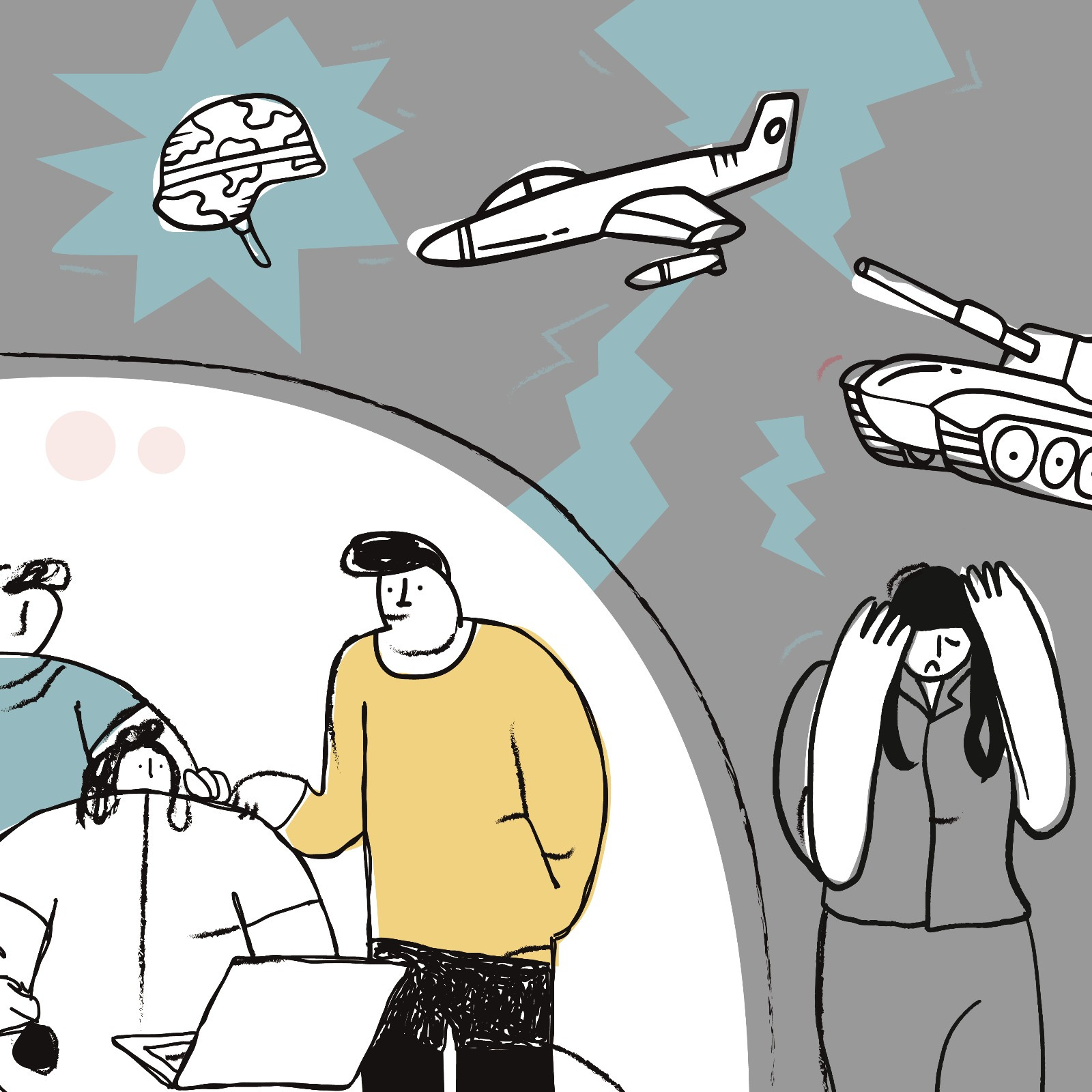
I want to focus further on those affected by war and conflict. Conflict doesn’t only destroy lives, buildings, and economies; it destroys time. Youth in those countries impacted by war are living in a “time pocket” and while we are having conversations about AI in 2025 and beyond, many Arab states are stuck in 1995 (at the dawn of the internet age) and others even in 1982 (pre-digital age). Their “war” environment has removed their access to technology and obliterated their chance of participating.
And if we are arguing that war leaves youth behind, what do you think it does to young women in those countries? Conflict compounds gender inequality. Women in conflict zones face early marriage, face mobility restrictions, carry domestic burdens, lose access to school earlier, face safety risks simply leaving home, and rarely have digital devices of their own.
So, if the region is splitting into two technological futures, women in conflict zones are two full revolutions behind: behind men in their own war-torn countries and behind the young men in stable countries. The Arab world is not just divided by war and peace; it is divided by access to the future. And women in war zones live at the farthest edge of that divide.
So this is where I landed after I read the article that my friend shared and after my mind drifted into an analysis into what is happening in the Arab World, first with an AI lens and then as a citizen of the Arab World: We cannot talk about the future of AI in absence of a conversation about how we can share a regional present or have a vision for regional future that meets youth at a respectable point of hope.
This is a regional problem, and unless we adopt a regional mindset, we will wake up to an Arab world split across futures it can no longer reconcile.
Guest Writer for Wishbox Media this month: Nermeen Murad Garlick
💡 What We’ve Been Up To
📷 Photo Essay: Underemployment in Jordan
This month, we published a photo essay exploring underemployment through the story of Yazan, a pharmacy graduate who now works on transportation apps to make a living. Despite years of study, Yazan has been unable to find work in the field he is passionate about. His story highlights the growing gap between education and meaningful employment for young professionals in Jordan.
This piece was produced within the framework of Qarib Media, a regional program implemented by CFI Media with support from AFD France.
📷 Photo Essay: This month, we also published a second photo essay—the final assignment of our two-year programme with Qarib (CFI Médias)—examining the impact of plastic waste on both the environment and human health.
In Jordan, each person uses an estimated 500 plastic bags annually, contributing to nearly 100 million plastic bags discarded into the environment every year. Overall, the country generates approximately 420,000–490,000 tonnes of plastic waste as part of its solid waste stream.
These figures highlight how deeply plastic pollution is embedded in everyday life, with consequences that extend across land and water ecosystems and pose increasing risks to public health.
📺 It’s a wrap": Our end-of-year video by Fesfori founder Basant Zeidan brought the year to a close, reflecting on the work, stories, workshops and collaborations. As we head into 2026, we do so amid continued uncertainty across the ecosystem for SMEs (Small and Medium-sized Enterprises), CSOs (Civil Society Organizations), and media organizations, marked by funding constraints, shifting priorities, and a rapidly changing digital landscape. Even so, we remain committed to our monthly workshops and producing independent content and to supporting journalists, photographers, designers and videographers who produce stories that respond to realities on the ground.
How Teens Use Social Media: United States vs MENA
While teens in both regions are highly active on video platforms, usage patterns diverge around communication and social interaction: WhatsApp plays a central role in MENA, while U.S. teens show relatively higher engagement with platforms like Instagram and Snapchat.
How Teens Use Social Media: United States vs MENA
📱 YouTube
MENA: 🟨🟨🟨🟨🟨🟨🟨🟨🟨 85%
U.S.: 🟨🟨🟨🟨🟨🟨🟨🟨🟨🟨 ~90%
🎵 TikTok
MENA: 🟨🟨🟨🟨🟨🟨🟨🟨 75%
U.S.: 🟨🟨🟨🟨🟨🟨 ~60%
MENA: 🟨🟨🟨🟨🟨🟨 ~55–60%
U.S.: 🟨🟨🟨🟨🟨🟨 ~60%
👻 Snapchat
MENA: 🟨🟨🟨🟨🟨🟨 60%
U.S.: 🟨🟨🟨🟨🟨 ~55%
MENA: 🟨🟨🟨🟨🟨🟨🟨 High daily use
U.S.: 🟨🟨 ~24%
🐦 X (Twitter)
MENA: 🟨 Low teen usage
U.S.: 🟨🟨 ~16%
Sources
United States: Pew Research Center, Teens, Social Media and AI Chatbots 2025
MENA: DataReportal / regional youth media surveys (2023–2024)
📺 Our Media Consumption
🤖 When AI Goes Live Too Soon at The Washington Post: The Washington Post recently launched an AI-generated audio feature that promised personalized news podcasts. Instead, it quickly ran into trouble. According to Semafor, internal testing showed the product routinely failed accuracy benchmarks, producing mispronunciations, misattributed quotes, and even fabricated content. Despite those warnings, the feature was released publicly, triggering internal concern about editorial standards and trust. A fascinating and troubling look at what happens when product speed outruns newsroom caution.
✍️ Growing your newsletter: In a recent Substack live interview, our contributor Natasha Tynes explores how creator Claudia Faith scaled her newsletter to 11,000 subscribers in a year by using AI as a support tool, not a replacement for thinking or voice. The piece draws a sharp contrast with newsroom missteps, showing how AI can amplify thoughtful work when guided by strong editorial judgment. A grounded, practical read for creators navigating the same tools.
🎬 Arab Female Filmmakers Make Waves at Red Sea Festival: At the 2025 Red Sea Film Festival in Jeddah, Arab female directors emerged as influential storytellers, winning top awards and centering new narratives from across the region. Films by Palestinian American Cherien Dabis, Saudi Shahad Ameen, and Jordanian Zain Duraie underscored a cultural shift where regional cinema is gaining global attention.
📩 Want to learn more about our work or want to reach out?
Connect with us at: wishboxmediame@gmail.com
 | A guest post by
|